
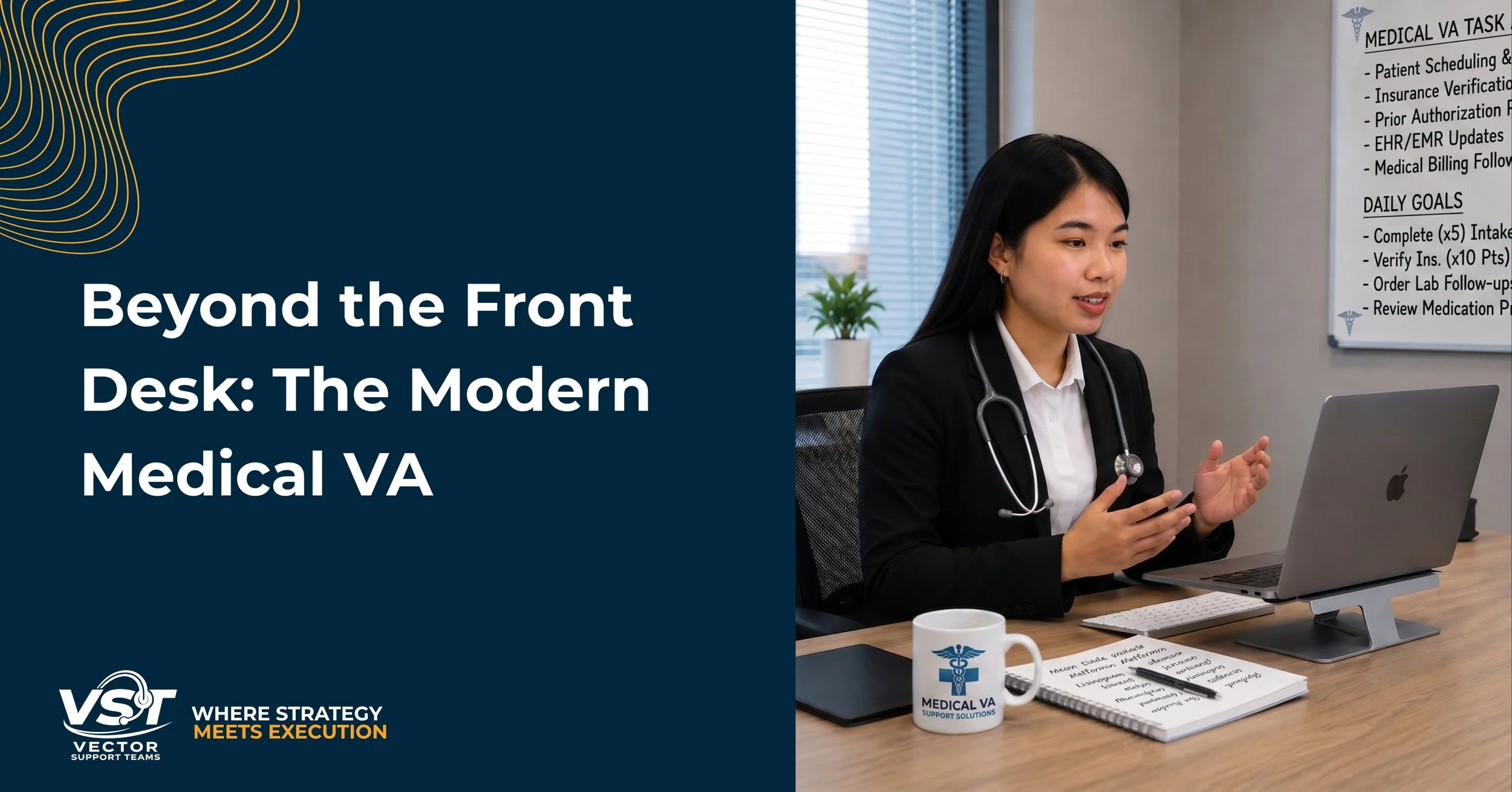
Beyond the Front Desk: The Modern Medical VA
For decades, the standard healthcare administrative model relied on a physical front-desk receptionist managing check-ins, answering phone lines, and filing paper records. But as healthcare delivery has modernized, the administrative load on medical practices has skyrocketed.
Today, physicians spend up to two hours on electronic health record (EHR) documentation for every single hour of direct patient care. This shift has created an operational crisis across private practices, specialty clinics, and medical groups: clinical staff are overwhelmed, providers are suffering from severe burnout, and patient wait times are rising.
The solution is no longer simply hiring another in-house receptionist. It requires deploying a modern Medical Virtual Assistant (Medical VA)—a specialized remote professional trained to handle complex, back-office healthcare workflows far beyond standard front-desk duties.
The Evolution of Medical Administration
A traditional receptionist handles physical patient arrival, local phone calls, and basic filing. A modern Medical VA, however, functions as a remote operational asset integrated directly into your practice management infrastructure.
By offloading complex administrative processes to a dedicated virtual professional, clinics decouple patient care from administrative bottlenecks, instantly increasing daily appointment capacity and overall practice revenue.
4 Complex Workflows a Modern Medical VA Handles Behind the Scenes
1. EHR Charting & Clinical Data Management
Manual charting inside Electronic Health Record (EHR) platforms—such as Epic, Athenahealth, Kareo, or eClinicalWorks—consumes critical provider energy. Modern Medical VAs assist with:
Gathering patient medical histories, previous diagnostic reports, and lab results prior to consultations.
Pre-populating patient charts with intake information to streamline the encounter.
Routing prescription refills and lab order requests directly through approved software channels.
2. End-to-End Prior Authorizations & Insurance Verification
Insurance friction is one of the leading causes of treatment delays and staff frustration. A dedicated healthcare VA manages:
Verifying real-time patient eligibility, co-pays, and deductible structures before the patient arrives.
Submitting prior authorization requests with required clinical documentation to payors.
Tracking pending claims and proactively following up on denied or stalled authorizations.
3. Patient Intake & Retention Management
Unattended phone lines and slow intake processes result in lost patient revenue. Modern Medical VAs optimize the patient journey by:
Conducting 24-to-48-hour pre-visit confirmation calls to reduce costly no-show rates.
Guiding new patients through online intake software and digital consent form submission.
Managing patient portal messages and routing urgent triage requests to appropriate clinical personnel.
4. Revenue Cycle Management (RCM) & Billing Support
Maintaining a healthy revenue cycle requires constant administrative follow-through. Healthcare VAs strengthen billing operations by:
Checking billing entries for missing demographic or insurance information prior to claim submission.
Reconciling patient accounts and following up on outstanding balances.
Assisting with medical coding entry and claim denial tracking.
Strict Compliance: The HIPAA Security Standard
Integrating remote support into a medical practice requires strict compliance with federal privacy regulations. Enterprise-grade Medical VA agencies deploy stringent security protocols to safeguard Protected Health Information (PHI):
Business Associate Agreements (BAAs): Establishing full legal compliance and accountability.
Encrypted Access Points: Accessing clinic systems through encrypted Virtual Private Networks (VPNs) with Multi-Factor Authentication (MFA).
Endpoint Security: Working on managed devices equipped with local download blocks, screen-printing restrictions, and clean-desk compliance policies.
In-House Clinic Staff vs. Managed Medical VA Agency
Operational Factor Traditional In-House Admin Managed Medical VA Agency
Total Cost High (Salary, health benefits, PTO, payroll taxes) Predictable, fixed monthly operational expense
Physical Overhead Requires office space, hardware, and desk space Zero physical footprint required
Sourcing & Vetting Weeks spent reviewing resumes and interviewing Immediate access to pre-vetted healthcare talent
Turnover & Coverage High risk; sudden staffing gaps halt clinic flow Built-in agency redundancy and seamless handoffs
Frequently Asked Questions
How does a medical virtual assistant access our clinic's software?
Medical VAs log into your existing EHR and practice management systems using individual, role-based user credentials created by your practice administrator. This ensures full audit visibility into system access.
Can a medical virtual assistant assist with specialized medical practices?
Yes. Modern Medical VAs adapt to various specialties—including dental, dermatology, mental health, orthopedics, and primary care—learning specialized medical terminology and clinic-specific workflows.
How quickly can a modern Medical VA be onboarded?
While traditional hiring takes 30 to 60 days, working with a dedicated agency allows practices to match, onboard, and integrate a pre-vetted Medical VA into existing workflows in as little as 1 to 2 weeks.
Reclaim Provider Time with Vector Support Teams
Your clinical providers should spend their time treating patients—not wrestling with software, insurance claims, and administrative paperwork.
At Vector Support Teams, we pair growing medical practices and healthcare organizations with highly skilled, pre-vetted virtual professionals who handle the operational heavy lifting. From patient scheduling to complex back-office administration, our VAs help your clinic lower operational costs, eliminate provider burnout, and scale seamlessly.
Ready to modernize your clinic's administrative workflow?
🌐 Explore Our Services:www.vectorsupportteams.com
✉️ Contact Our Team: Reach out directly at info@vectorsupportteams.com to schedule your operational discovery call.
